Full Stack Mathematician.

Howard builds and deploys algorithms that combine physics-based modeling with data to maximize the performance of complex, constrained systems. He has worked with teams in medical imaging, e-commerce, physics-based animation, and trading crypto on blockchains. Through Typal Academy, he shares insights in the field of optimization and its interface with deep learning.

Education.

University of California, Los Angeles
Ph.D. Mathematics Thesis: Learning to Optimize with Guarantees 2021
M.A. Mathematics Qualifying Exams: Numerical Analysis, Applied Differential Equations 2018
Walla Walla University
B.S. Computer Science, Mathematics, Physics 2016
UCLA
DegreePh.D. Mathematics ThesisLearning to Optimize with Guarantees  
DegreeM.A. Mathematics Qualifying ExamsNumerical Analysis, Applied Differential Equations
Walla Walla University
DegreeB.S. Computer Science, Mathematics, Physics GPA3.97 / 4.00 Year2016
PhD Advisor: Wotao Yin
PhD Advisor: Stanley Osher
Mentor: Yair Censor
Mentor: Reinhard Schulte

Academic Research.

Howard's research originated in convex feasibility problems and iterative projection methods. In graduate school, this expanded to first-order optimization algorithms (e.g. operator splitting) and using machine learning to speed up algorithms and/or modify optimization problems to best utilize knowledge hidden in historical data (e.g. for inverse problems).

Google Scholar Profile

Invited Talks.

Industrial Problems Seminar, IMA at University of Minnesota Nov 21, 2025
Convex Optimization, Data and Research in Industry
Optimization problems and big data arise all over in industry. This talk will walk through examples of these problems and highlight how optimization solvers can be informed by data (e.g. decision-focused learning). Discussion will then transition to lessons learned from research positions in various fields.
AI Meets Optimization, ICCOPT Session at University of Southern California Jul 22, 2025
Differentiating through Solutions to Optimization Problems in Decision-Focused Learning
Many real-world problems can be framed as optimization problems, for which well-established algorithms exist. However, these problems often involve key parameters that are not directly observed. Instead, we typically have access to data that is correlated with these parameters, though the relationships are complex and difficult to describe explicitly. This challenge motivates the integration of machine learning with optimization: using machine learning to predict the hidden parameters and optimization to solve the resultant problem. This integration is known as decision-focused learning. In this talk, I will introduce decision-focused learning, with a particular focus on differentiating through solutions to optimization problems and recent advances in effectively scaling these computations.
ACMD Seminar, National Institute of Standards and Technology Mar 7, 2023
Explainable Models via Data-Driven Optimization
Flexible, human-interpretable machine learning models are gaining interest as applications increasingly require explainable artificial intelligence. This talk overviews recent developments in the "learn to optimize" (L2O) methodology wherein model inferences are defined to be solutions to parameterized optimization problems. The idea is to have domain experts create intuitive optimization models that include both analytic and parameterized terms. This fusion merges data-driven modeling with strong analytic guarantees (e.g. inferences satisfying linear systems of constraints). We will cover the key tools needed to design and implement L2O models along with numerical examples.
Industrial Problems Seminar
InstitutionUniversity of Minnesota TalkConvex Optimization, Data and Research in Industry DateNov 21, 2025
AI Meets Optimization
EventSession of ICCOPT InstitutionUniversity of Southern California TalkDifferentiating through Solutions to Optimization Problems in Decision-Focused Learning DateJul 22, 2025
ACMD Seminar
InstitutionNational Institute of Standards and Technology TalkExplainable Models via Data-Driven Optimization DateMar 7, 2023

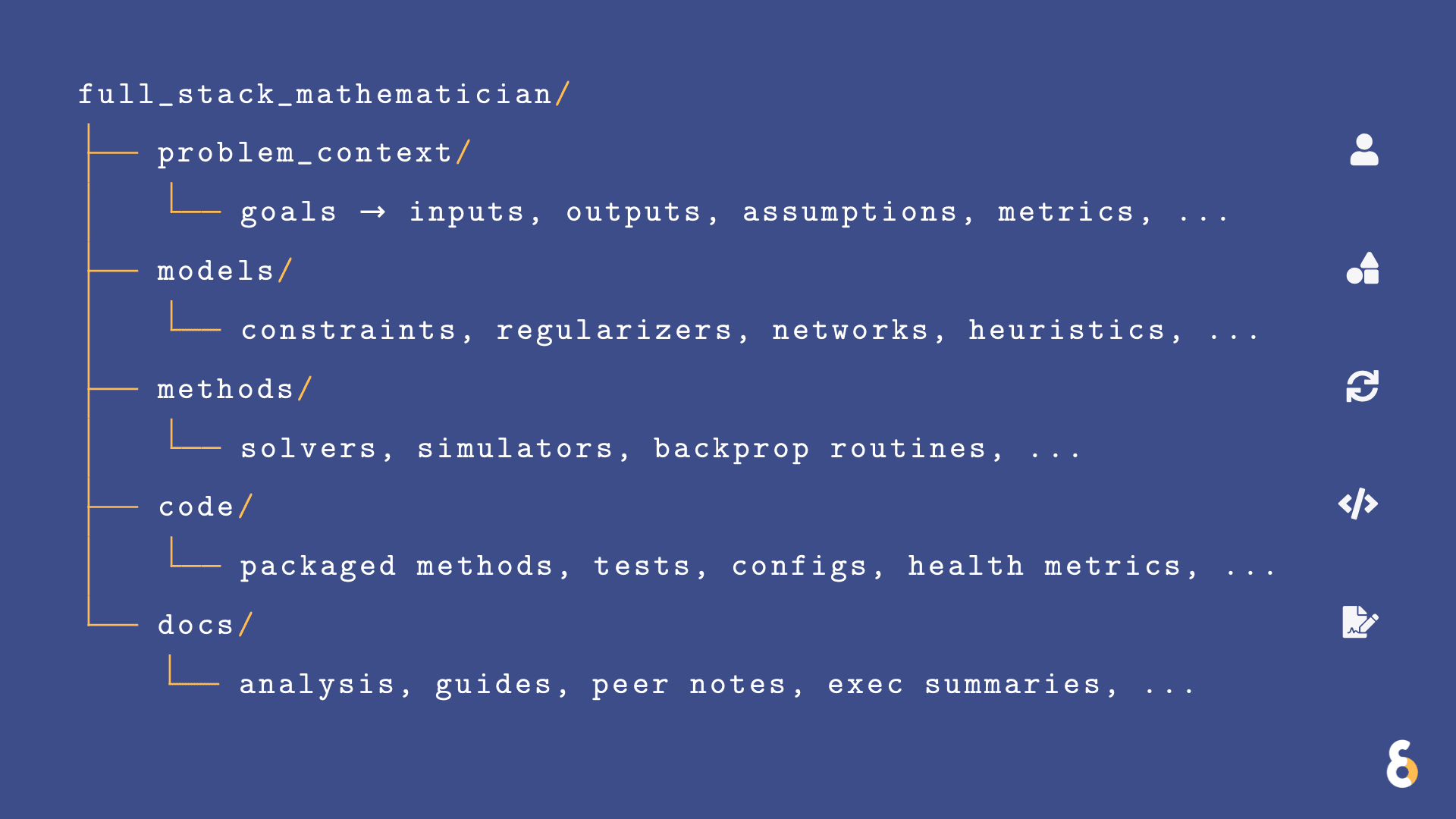
What is a Full Stack Mathematician?

Someone that can take vague goals and constraints and own the process for developing algorithmic solutions in code that engineers can use. They also provide documentation and reports so people know how to use the math safely and interpret results, e.g. guides for engineers and clear summaries for leaders.

Email Newsletter.

Howard writes short posts, each illustrating concepts in his area of work.

Podcast.

Howard hosts the podcast "Numerical Optimization" where he interviews mathematicians in various optimization specialties.

Listen to Podcast